16 Blocks
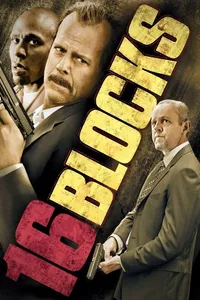
When you go into a Bruce Willis action movie, you expect Bruce Willis action movie. Unfortunately, “16 Blocks” is like ordering a slab of ribs and getting served a Boca Burger instead - confusing texture and odd aftertaste to boot.
First of all, by no calculation is the 16th Precinct of the NYPD 16 blocks away from the criminal courts downtown at 100 Centre Street.
Additionally, why is is that getting from Chinatown to lower Manhattan, a trip of four tenths of a mile, takes 118 minutes? You can’t even take the subway from Elizabeth Street and Canal to 100 Centre Street, it’s that minute of a distance.
And who refers to something as being 16 blocks away? No one will ever refer to anything as “nine point nine three nine miles,” “two minutes and eight seconds” or “16 blocks” away because it’s a silly distance. With simple reasoning, you can refer to something as three or four blocks away, but 16? Who sits down with a map and counts 16 blocks?
“16 Blocks” isn’t the kind of movie that’s supposed to make your brain hurt. Jack Mosley, has-been alkie cop, sits in an empty New York City bus, reading a fatalistic, gravelly last will and testament into a dictaphone. Flashback to earlier that morning, when he’s charged with transporting a federal witness – the nasally nattering Mos Def, as Eddie - from precinct lockup downtown to the criminal courts building in Manhattan. He has 118 minutes before the case gets thrown out for lack of said witness. About two hours of claustrophobic chases and wily escapes ensue, chock full of the obligatory scenes of rooftop runs and men clutching bloody wounds as they scrape through the city streets later. Panting and tense, we’re ready for a grim, but tidy and satisfying happy ending, i.e. Willis achieves transfiguration but dies and Eddie gives his vital testimony, solemnly thanking his lucky stars for the cop who gave his life for the scrappy young black man cursed with Fran Drescher’s vocal chords.
But no. By the closing scene, the major plot points have been wrapped up in such a embarassingly cute way that “Shaggy Dog” looks dark and nihilistic. The good guys live, the bad guys die or confess their evil deeds in detail and the audience learns that if someone scribbles his dreams in one of those black and white marbled Mead notebooks (kept folded into his back pocket, a la “The Basketball Diaries”) he’s good at heart. Talk about deep hurting.
At the same time, so many meaningless plot points have flashed arrows in misleading directions that your face will mirror that of Willis, who wears the sour expression particular to someone who’s about to splatter a fifth of whisky and stomach acid on your shoes.
And oh, ye gods, it’s unpleasant to look at that face for two hours – the combover, the straw moustache, the tired grimace of someone who’s pickled the moral qualms of occupational corruption in Canadian Club. (It’s not like we get much else to look at. The movie so lacks in New York flavor it’s the cinematic equivalent of nursing home creamed corn.)
Totally absorbed within his character’s throbbing dehydration headache, Willis believes he really is the washed-up middle-aged Jack Mosley. What’s most disturbing is he’s just a little too good at it. (When he tells the Chicago Sun-Times things like “I don’t think that I could have played Jack Mosley 10 years ago. I had to grow into certain roles. I needed the life experience,” that doesn’t help.)
I mean, this is Bruce Willis we’re talking about here! “Die Hard’s” Everyman versus the terrorists John McClane! Butch the fatherless boxer hero from “Pulp Fiction” who refuses to throw the fight! Korben Dallas the cab-driver hero who saves the world in “The Fifth Element”! But “16 Blocks,” a public service announcement against joining the fuzz, comes off like a rehashed 21st century version of the infamous 1975 drunk has-been cop bomb “Mitchell.” Bruce Willis doesn’t deserve to become this century’s answer to the half grease stain, half belch that is Joe Don Baker. And anyway, isn’t that what we have Steven Segal for?
Ashley O’Dell reviews movies that aren’t in the theater anymore.