Australia
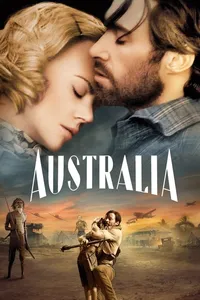
Baz Luhrmann writes and directs best when he’s limited. In the final scene of his “Strictly Ballroom,” a couple ordered to leave the competition dance floor have their music cut. The crowd begins to clap rhythmically. They begin their flamenco anew, to that sound alone. Their dance — without the music — is far more powerful than when the lush, synth-ey instrumental accompanies them.
Luhrmann’s best work is “Romeo + Juliet.” With William Shakespeare doing all the dialog, Luhrmann’s talents are concentrated in style — scenery (the star-crossed lovers in a brightly lit chlorine swimming pool), pacing (exposition voiced by a deadpan TV newscaster) and music (Leonardo DiCaprio, a melodramatic Romeo, mopes about the hazy-sunned beach at sunset, scribbling poetry, smoking, to Radiohead’s “Talk Show Host”).
Not that “Australia” is lacking in style — in addition to its $130 million budget, it also has some of the most beautiful nature at its disposal. The problem with “Australia” is that the continent, the glamor-magazine costumes, the glitter power of Nicole Kidman and Hugh Jackman, the flying shots of salt flats and burning islands and canyons and destroyed ships — only serve to highlight the flaws in character, message and story.
Those flaws begin with the awe-filled dialect voiceover of Nullah, the product of an evil white man and a tragic servant Aboriginal woman: “My grandfather, King George, he take-um me walkabout, teach me blackfella way. Grandfather teach-um me most important lesson of all: Tell-um story.” The voiceover is Jar-Jar Binks bad. It’s early-television, Lucille Ball (“Mr. Indian, me heap sorry me smackum on coco”) bad. With every option available to him with this production, Luhrmann flounders.
From the get-go, the love story — and most of the rest — is Disney-predictable and just as focus-grouped.
It’s slapdash to compare “Australia” to “Gone With the Wind” — both tell antebellum tales of high-falutin’ dames, the whisky-rough men they try to domesticate, the background chorus of attentive, disheveled, darker people who draw their candle-lit sponge baths for them and the one-dimensional carpet-baggers always after their land.
But when Vivian Leigh and Clark Gable smash together, one needs smelling salts and a fan. Kidman and Jackman try to muster lust and merely look seasick.
Things started to go downhill with Luhrmann — and Kidman — in Luhrmann’s 2001 musical “Moulin Rouge!” (tacky exclamation point his). Despite picking songs that already existed to flesh out the movie, Luhrmann isn’t limited enough and the movie melts like a microwaved brie. Kidman, on the other hand, chilly in “Moulin Rouge!” is frost-bitten in “Australia.” She did the haughty-heiress-does-hardscrabble-on-an-untamed-continent in 1992’s “Far and Away,” (not Luhrmann’s) her stuffiness a mask concealing a tough but scared dame that love and circumstances crumbled, to great effect.
In “Australia,” she’s nothing but the prim mask. Luhrmann shot three different endings for “Australia,” tested two — a tragedy and a happy one — and went with the third. It’s a method that served well for the Choose Your Own Adventure series. But let’s not pretend the “most important lesson of all” is to “Tell-um story.” Even Luhrmann doesn’t buy that.
Ashley O’Dell reviews movies that aren’t in theaters anymore.