Borat
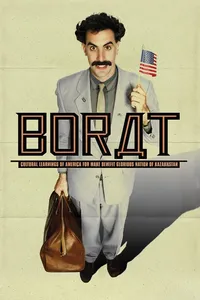
It’s too bad that by the time “Borat: Cultural Learnings of America for Make Benefit Glorious Nation of Kazakhstan” made it to the foot-dragging cinemas of Hinterlandsylvania, it was a stale cracker of a movie, exposed to so much hype that, unless you were tooling around in a nuclear sub for the previous year, your eyes watered at the rehash.
The premise is that Borat Sagdiyev, an enthusiastically boorish Kazakhstani journalist with a tenuous grasp of English, has come to America to tell his countrymen about it. For example: “America national sport is called baseballs. It very similar to our sport, shurik, where we take dogs, shoot them in a field and then have a party.”
Borat is really Sacha Baron Cohen, a British chameleon of a comedian who can convincingly pass as “Mockney”-speaking “voice of da yoof” Ali G (and, in a few days, the title character in “The Dictator”). The shtick is this: by affecting an impermeable facade of dullness and a sincere documentary style, his interview subjects remove the gauze from their messages to reveal their hideous absurdities.
Take Borat’s trip to a Virginia rodeo, shot two years before the movie came out.
Borat, with a bright American flag shirt, turquoise bolo tie and cowboy hat, is welcomed onto the grounds by rodeo organizers, where he woos the crowd by telling them, in a heavy faux-Russian accent, that in his country, “We support your war of terror.” The audience cheers. He follows with, “May Supreme Warlord George W. Bush drink the blood of every single man, woman, and child of Iraq!” Again, the cheers. So he pushes a bit more. “May you destroy their country so that for the
next thousand years, not even a single lizard will survive in their desert!” You can almost hear the collective “huh?” in the half-silence as the applause dies down and the audience begins to wonder if they’ve been had.
Most of the time, his subjects get off pretty clean. A driving instructor tells him honestly that, in America, women have to consent to sex. A humor instructor gently breaks it to him that jokes about
his disabled brother won’t bring in the laughs here. But the best, gooey dark humor isn’t in Borat making a git out of himself, but in what he gets a cross-section of America to reveal about itself.
Fashioning himself as a sort of Kazakhstani good ol’ boy, the cameras roll as the rodeo director tells him to shave his mustache, because it makes him look Middle Eastern. He rebuffs Borat’s attempt to greet him with a cheek kiss because it looks gay, which Borat certainly doesn’t want. In his country, they hang homosexuals, he says. The director is instantly a kindred spirit. He chuckles and says, “That’s what we’re trying to do here.”
Nearly the same filth is exposed when Borat spends a beery night with three Nascar and Stars and Bars-loving South Carolina fratboys, who vocally long for the days of slavery and gripe about how, they say, minorities now have all the power. Two of them, after the movie came out, sued for “humiliation, mental anguish, and emotional and physical distress, loss of reputation, goodwill and standing in the community.” They may be steeped in Greek, but maybe they’d be better served by a little knowledge of Latin. In vino veritas, guys. There’s truth in them thar Miller High Lifes.
Borat brings out the stereotypes on both sides. The feminists he meets with in New York (who are appalled at his statement that women have brains the size of squirrels) couldn’t be more sour on him if
they were made out of Mega Warheads candies. And sour is definitely the reaction he gets when he brings a two-ton prostitute straight out of an R. Crumb comic to a finger-bowl-Southern society supper. When she shows up on the doorstep, the two are thrown out.
On the contrast, some of his subjects turn out looking golden. Like the cheerful homosexuals in the gay pride parade in Washington, D.C., who sparkle like homecoming cheerleaders. Or the inner-city homeboys in Atlanta, who laugh and josh with Borat about music and fashion, totally unfazed. And then there’s the elderly Jewish couple who own the kosher B&B where Borat, a monolithic anti-Semite, stays one night. They bring him a sandwich and all but tuck him and his crew into bed. When they were told about the film, they dismissed accusations that it was anti-Semitic (Baron Cohen is Jewish). “It was outstanding,” they said, and called him “a genius.” That, folks, is called rolling with the punches (see also the LDS church’s response to the “Book of Mormon” musical).
But that’s the exceptional response. Our nation is far from perfect, so far that sometimes we’re as bad as Borat’s purported hobbies in Kazakhstan (disco dancing, archery, rape, and table tennis). In 1997, John Waters, genius director of such cult hits as “Pink Flamingos,” “Hairspray,” and “Desperate Living” said that it was nearly impossible to gross people out anymore, that audiences were too savvy, too hip. More than ten years later, though, we’ve collectively regressed, and the grossest thing about America in the 21st century is how easily we are shocked and offended, eager to call “bully!” on anything that’s not ambrosia salad and Dora the Explorer. Borat has become what Waters’ films were once described as: “a hostile dialog,” with so many of those engaged scrambling to get the gold star for humorlessness. If being offended were a gun, we’d be trigger happy. And dead. Thank goodness for Cohen, for continuing to prick us when and where we most need it. No apologies necessary.
Ashley O’Dell reviews movies that aren’t in the theater anymore.