Brand Upon the Brain!
Paint Snoopy on a canvas — using marmite — and call it “Peace Treaty.” Cut up the instructions on a box of condoms and mix them in with your grocery list and read it at your next coffee shop open mic. Hold an exhibition of sculpture, called “She’s not the messiah,” where all your pieces consist of grainy projections of chickens scratching around a dismantled suit of armor, set to the sound of eggs sizzling in a frying pan.
There are plenty of people who burst out laughing when, in a round of joke-telling, someone spits out the old nonsense joke (“How do you stop your granny stealing your cheese? Paint your walls pink!”). Back in middle school, this was a good way to tell who was trying too hard to fit in and feel smart. Fast forward a few years, and these are the types of people who will drink down movies like “Brand Upon the Brain” like Oreo Blizzards.
The rest of us must remain content with the brain freeze.
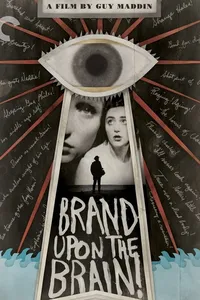
Writer-director Guy Maddin cloaks his 12-chapter navel-gazer as a silent film about a boy enslaved by his orphanage-running tyrant mother and mad scientist father. His pretty older sister lures away his one true love, Wendy. Had the production scaled down its ambitions, it actually could have been a grander movie. Instead, it piles on effect after effect — sound effects that fail to blend and are too-obvious character motifs, a “telescope” through which the film is viewed, frantic cut sequences to imply, well, a sense of franticness, and worst of all, the dual narration of cards and an overwrought, perpetually close to tears, Isabella Rossellini.
The cards read like bad, fan-created anime — “Home again!” “A heart swollen with hidden emotions!” “Boy crush!” “Always to please! Always to please!” “Secrets! Secrets! Secrets!”
At the same time, the audience is subject to the repetition by Rossellini — “The past! The past! Eeento the past!” she murmurs tremulously. Rossellini has the kind of voice best suited for short makeup ads. (You learn a second language surrounded by sycophants and you’ll almost certainly end up mispronouncing “color” and “it’s.”)
Beyond her poor enunciation, one feels embarrassed on her behalf. “Brand Upon the Brain” is certainly not intended for the “Sesame Street” set, which needs such repetition because it’s still learning how to speak. (Remember those silhouette figures? “Puh.” “Urple!” “Purple!”). No, this repetition feels like it’s trying to hide within some high form, when really the film has little to say beyond “parents can be scary and it can hurt when your older sister wins the heart of the girl you love.” You can see the same thing any day on the Dr. Phil show — and with better fights.
It’s easy to make surreal art that fools. The fact that 500 artists selected Marcel Duchamp’s “Fountain” (an old porcelain urinal, which he signed) as the most influential artwork of the 20th century, says not that those artists had superior taste or vision, but rather that they were deeply fearful of not “getting” something.
The joke is that sometimes, as in “Brand Upon the Brain,” there’s very little to get.
Ashley O’Dell reviews movies that aren’t in theaters anymore.