Call Northside 777
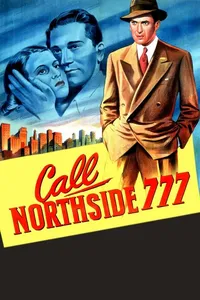
Gotta be honest. Any classic noir piece is usually an automatic rave from me, but not “Call Northside 777,” even though it’s all about an intrepid crime reporter investigating a possibly wrongly convicted murderer.
The movie is burdened with a voiceover narrator and a nine and a half minute exposition that informs the viewer that This is a True Story!, that in 1944, a reporter at the Chicago Times was able to exonerate a Polish man wrongly framed for the 1933 murder of Chicago Police Officer William D. Lundy. But, in truth and on screen, this is not such a nice tale. In reality, a low-ranking reporter pointed out the classified ad — “$5,000 reward for killers of Officer Lundy on Dec. 9, 1932 Call Gro. 1758, 12-7 p.m.” — which turned into an assignment for the crime reporter, James McGuire. The story might not have been written were it not for the heartstrings angle; the mother of the man convicted for the crime had scrubbed floors for 11 years to save up the $5,000 for the reward. Someone dug up the clips for him, and he learned about how “delicatessen” (cough-speakeasy-cough) owner Vera Walush provided the sole eyewitness testimony got a man locked up for life.
So judging from the number of misinformed voicemails and emails I’ve gotten over these last six years, I gather that many in the public think that reporters 1) get paid more if they get on the front page 2) get paid more if circulation goes up 3) get paid more if an article causes controversy 4) are willing to make up quotes, slant a story towards absolute fiction and disregard blatant truth in order to accomplish 1-3. Unfortunately, “Call Northside 777” does nothing to dispel these cliches — which, if they were true in the 30s, certainly haven’t been true for the 14 years I’ve been involved with newspaper writing — on both the news and opinion sides.
While this is incredibly irritating, the story of the reporter (“McNeal” in the movie, played by Jimmy Stewart) is just too easy. At first, McNeal is reasonably skeptical of the story — if I had a dime for every time a female relative called in wanting to protest, many times angrily and with threatening language not suitable for a family newspaper, about the absolute innocence of her son or brother, I could afford to go to first-run movies at the theater. His editor allows him the immense time to work on nothing else, and he combs every Polish bar and tavern and police precinct, pulls photo records from four newspapers from back in the day, and churns out sensational one-source articles without ever taking a note. His resulting articles, with made-up, fictionalized quotes, are written in a skin-crawling tabloid style that relies on imagination and implication rather than the staid, lawyer-friendly standbys of legal documents and on-the-record quotes from officials, witnesses and lawyers. No, reporters don’t print the full text of their interviews (the “hmms” and “ahs” and digressions would double the length of the story) — but if I ever met someone who printed a quote without taking a note of it, I’d take him out back and beat him senseless with a pica pole.
There are some truly good parts in this proto-”Unsolved Mysteries” episode. The part where the reporter’s savvy wife, fiddling with her jigsaw puzzle, notes, “the pieces never make the wrong picture.” Where a still-cynical McNeal notes, of the murdered officer, “maybe he had a mother that scrubbed floors too.” Where the also-jailed alleged co-defendant tells McNeal, when asked what really happened that night, “That’s the trouble with being innocent. You don’t know what really happened.”
And that’s the thing — even with the court of public opinion, we never do find out who actually killed that officer. The crime exists in a Prohibition vacuum; there are implications of pay-offs and impropriety (the murdered cop’s last words are telling the speakeasy proprietress he’s getting a cold, an easy excuse for many to get a shot of booze back in the day) but we only find out what didn’t happen. And that’s something that the first 10 minutes of exposition told us.
“Call Northside 777” is rich and intoxicating to watch just to see Chicago in the barely-out-of-the-Depression days, with the Polish Holy Trinity Church looming over the scrappy Back of the Yards Polish neighborhood, the white paint-slathered metal bars of the echoey state penitentiary, where a guard in the middle of a circle of cells, stories of them, can see all — and the warden grants interviews right in his office, to inmates allowed belts and button up striped shirts and cigarettes. This was the first time a movie had ever been filmed on-scene in Chicago, which is amazing, but lends a million times to the stunning imagery of the just barely post-war world in America’s second city. And there’s a part, at the end, about photo enlargement and wire services and pardon boards, that will make your cell phone cameras seem like time-traveling DeLorians, so I won’t disclose it. “Call Northside 777” is an excellent piece of history, a good reminder of the importance of technology in the field of research and reasonable doubt in the legal system. But as film, it just passes the board.
Ashley O’Dell reviews movies that aren’t in theaters anymore.