Charlie Wilson's War
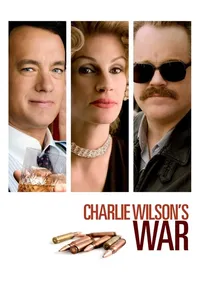
Back in the days of Donna Summer and “Dallas,” when news junkies got their fix from wire machines, there was a Cold War everyone knew about and a real war, between playboy Soviet pilots who got their kicks from strafing Afghan villagers to the rousing sounds of the Proshchanie Slavianki march and the noble Afghans, pawns in a Communist play for Middle Eastern dominance. Based on the George Crile book, “Charlie Wilson’s War” is the story of the Texas congressman (played by Tom Hanks, who co-produced the movie) who, in the 80’s, through a precise chemical combination of swagger and whisky, was able to negotiate peace on a scale that ranged from nativities on the firehouse lawn to
driving the Soviets out of Afghanistan without letting anyone know where the mujahadeen were getting their helicopter-destroying Stingers.
In a movie about spending money wisely, it appears the bucks spent on production were also spent smartly. You could spend 103 minutes online, watching the vintage, stenographic, bloodless BBC reporting of the day, but judging that the second most viewed video when you search for Soviet-Afghan war is a domestic production called Funny Army Dances, not too many people are digging for this stuff. But in Aaron Sorkin’s (“A Few Good Men”) hands, with a brooding, window-smashing
Philip Seymour Hoffman, Hanks’s All-American protagonist (who wonders if they wouldn’t just be happier over there if they could get alcohol and women in the same room) and enough shoulder-mounted grenade launchers, strippers and bellydancers to populate a James Bond movie, it all goes down like a Bombay martini instead of the head-spinning guilt trip it ends up as.
Guilt trip? But we defeated the Red Army! How wonderful for us! As Hoffman’s Zen-master in Langley, Gust Avrokatos, says, “We’ll see.” Because then we bailed on Afghanistan. In Charlie Wilson’s words, “we always leave and the ball keeps bouncing.” To paraphrase his final words of the movie, “we effed up the end game.”
It’s quite a balancing act, telling a story of a multi-year, multi-agency, multi-country covert military operation in a way that satisfies most poli-sci historians while still appealing to your average fan of Julia Roberts (who must have employed the same Connecticut voice coach as George W. Bush for her “Texas” accent).
One historian blasted “Charlie Wilson’s War” for not name-dropping Reagan enough, and for dropping the f-bomb too much. An AlterNet essay rages that the big lie of the movie (but not the book) is the
disappearance of muj leader Gulbaddin Hekmatyar. The movie claims that the money went just to assassinated Afghan leader Ahmad Shah Massoud, while more than 40 times more went to Hekmatyar, who’s alleged to have spent it more on his countrymen than the Ruskies.
Yeah. You go ahead and make a movie with all the details. Let me know how that works out for you, in a world where foreign policy is a wart on the toe of who Lindsay Lohan is holding hands with. Even John McCain — who to his credit probably doesn’t know who Sam Ronson is — has confused Iraq and Afghanistan’s borders.
“Charlie Wilson’s War” will strike some as incomplete, because what really happened is always going to be more complex and nuanced than you can fit in a movie. Hopefully, for the majority, it will serve as jaw-dropping history. It’s an absorbing, entertaining success and, as the outline to a social studies lesson the vast majority of Americans have never heard of, it does what most movies neither achieve — nor even aim for.