Doubt
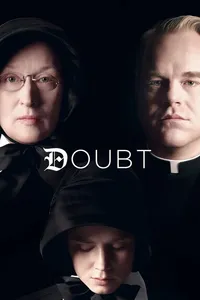
It’s 1964 and Philip Seymour Hoffman is a young, kind Catholic priest brimming with pearls of wisdom: “Last year, when President Kennedy was assassinated, who among us did not experience the most profound disorientation? … It was awful, but we were in it together. How much worse is it then for the lone man, the lone woman, stricken by a private calamity? ‘No one knows I’m sick.’ ‘No one knows I’ve lost my last real friend.’ ‘No one knows I’ve done something wrong.’” He’s Ira Glass in a cassock.
As the sermon continues, we meet Sister Aloysius (Meryl Streep), who’s glided up an outside aisle to smack, hard, on the back of the head, a boy leaning forward and whispering in his pew. She cracks her mouth and out comes a New York spinster, the kind who would wear a plastic rain bonnet and gripe at the bag boys for manhandling her plums.
Then, there’s quiet eighth-grader Donald Miller, the school’s first black kid. He’s having a little bit of a tough time, but Father Flynn’s taken him under his wing … And you see the icky place this is going, don’t you? Or rather, you think you do. And not in an M. Night Shyamalan, wait-for-the-twist way.
The theme of “Doubt” (2008, rated PG-13) is obvious, but not gallingly so. A lesser movie would push the envelope straight to seedy at this juncture. (Especially when you consider that “Doubt” was
written and directed by playwright John Patrick Shanley, who wrote and directed “Joe Versus the Volcano.” It’s like one of the writers of “Troop Beverly Hills” going on to pen “Amélie.”) But instead of taking “Doubt” into Dakota Fanning/“Hounddog” territory, we meet Mrs. Miller.
Mrs. Miller is Donald’s mother, played by Viola Davis, whom we can now forgive for taking part in “Nights in Rodanthe.” Her husband beats her boy and she’s worried that if there’s any trouble in school, he won’t be able to go on to the good life of the college educated. She doesn’t want any trouble. Davis doesn’t play it dumb, the kind of character sense can be slapped into. She’s a weeping Madonna in a pillbox hat.
Father Flynn has another good sermon about a chatty woman whose priest advises her to go to her roof and hack up a pillow: “‘And what was the result?’ ‘Feathers,’ she said. ‘Feathers?’ he repeated. ‘Feathers
everywhere, Father!’ ‘Now I want you to go back and gather up every last feather that flew out on the wind!’ ‘Well,’ she said, ‘it can’t be done. I don’t know where they went. The wind took them all over.’ ‘And that,’ said Father O’Rourke, ‘is GOSSIP!’”
In matters of faith, doubt’s worse than gossip. Doubt’s only good when it’s an ultimately circular path, leading you home and all the happier you made it back. Strike out and away? You’ll never be able to gather up those feathers. Ask Mrs. Miller.
As the unease unfolds, it’s impossible to side with Father Flynn — but also impossible to loathe him. He does make a convincing case that Sister Aloysius just hates him “because he uses a ball-point pen and takes three lumps of sugar in his tea and likes ‘Frosty the Snowman,’” as Sister James (Amy Adams) explains so well.
Someone’s got the right theory. But who? Father Flynn, protesting his innocence? Sister Aloysius, convinced — almost — to the depths of every black crepe pleat that he’s a pederast and willing to destroy him for it? Or, worst of all, Mrs. Miller?
It’s enough to make your brain flip back and forth like a perpetual motion dolphin toy. Not a pleasant feeling to reconcile with “God has His reasons.” What, one thinks, could possibly be God’s reason to allow abuse? If confession cleans one in the eyes of their Lord, what is the role of human justice? “Doubt” has no easy answers. That’s why it’s a hell of a good movie.
Ashley O’Dell reviews movies that aren’t in the theater anymore.