Fireman, Save My Child
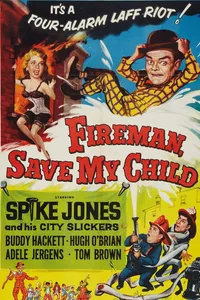
Cowbells. Washboards. Rib xylophones. Percussion pistols and flatulent brass. Tinkling chandeliers, tin cups. Parachuting ducks. Sneezing, clucking, poly-glottal glugging. You’re never going to see stuff like Spike Jones and the City Slickers anywhere else. No, not Spike “Jonze,” the hiply re-named Gen-Xer behind the cinematic think-piece “Being John Malkovich.” That guy’s a phony, riding on the zoot suit-wide, crazy plaid of mid-century band-leader Spike Jones, the manic star of “Fireman, Save My Child.”
“Fireman” is about firehouses 100 years ago in San Francisco going through the transition from horse-drawn carriages to internal combustion. That doesn’t get your attention, but neither does it get the attention of Lt. Mac McGinty (Spike Jones), who would rather lead his firemen in boisterous, yet technically perfect renditions of
everything from the hillbilly “Pass the Biscuits Mirandy” to the Austrian opera of Franz von Suppé (“Poet & Peasant” overture). As the movie opens, Spike, grinning as he furiously chews gum, is leading his orchestra as he plays “Mirandy” on a long row of perfectly tuned, different sized firehose nozzles (cowbells, in reality).
This is how he strikes fear into the heart of an underperforming musician: “You don’t want to go back to the Boston Symphony, do you?”
One doesn’t really care how this 80-minute slapstick moves toward the closing credits — “There may or may not be a plot to this story,” an opening title card warns. “if you can’t find it, don’t worry about it.” Things happen, and so-called leads Smitty and Smokey (Buddy Hackett and Hugh O’Brian) plod through their hokey dialog and screeching delivery, as a way of killing time between fantastic, on-a-shoestring musical performances.
It’s a good thing televisions weren’t in color when Spike Jones came on (preceding a particularly complicated, mad performance with a “Good luck,” to the audience). His screamingly giant plaid suits would have imploded cathode ray tubes across America. Of course, Jones, whose musical supplies included pistols, machetes and a grenade (worn, stylishly, on his lapel, until the crucial moment) probably would have liked that. (Other immediately must-see Spike Jones-ified show-stoppers, not performed in “Fireman” but available on YouTube,
include a 7-minute version of Bizet’s entire opera “Carmen,” the Big Band crooner “Cocktails for Two,” and Tchaikovsky’s “None But the Lonely Hearts,” turned into a soap opera of Jerry Springer intricacies.)
The punchline to Spike and the City Slickers’ gags was an arrogance in spite of appearances. George Rock, an obese, scowling trumpet player with a high, whiny voice spits when he talks, but when he lifts the instrument up, his fat fingers nimbly fly on the valves. Freddy Morgan bounces dumbly on stage, a gawping grin and a bowl haircut, then jams on his banjo so quickly he looks like he’s in fast forward, or enters into an Ink Spots cover with the deepest, sultriest bass voice you’ve ever heard. The trombonists have their slides attached to their pant
cuffs — or the top of their trousers. The serious, mad scientist-haired Sir Frederick Gas nervously stumbles onto the stage to perform a violin solo using twigs.
Sadly, most people know about “Fireman” because it was originally written for Bud Abbott and Lou Costello. As far as I’m concerned, those two wouldn’t have been able to hold their own next to the City Slickers. Only Chaplin or the Marx Brothers would have been able to maintain the wide streak of insanity. Abbott and Costello would have come off like Buddy Hackett and Hugh O’Brian do, outclassed rubes. Maybe that’s why the famed slapstick duo got cold feet. With or without them, Spike and his boys couldn’t help but steal the show.
Ashley O’Dell writes about movies that aren’t in theaters anymore.