In Bruges
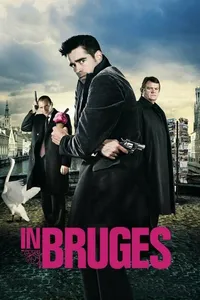
The audience is likely to feel a lot like Ray (Colin Farrell) at the beginning of “In Bruges”:
“I didn’t even know where Bruges f***ing was. It’s in Belgium.”
Thanks, Colin. In writer-director Martin McDonagh’s weighty, awesome feature debut, we accompany Ray — and his partner, Ken (Brendan Gleeson, a.k.a. Mad-Eye Moody from the Harry Potter movies) on a two-week Christmas furlough as the two hitmen hide out from the law after a botched killing in London.
By the very end of the journey, we’re liable to feel a tiny bit screwed over. A cool character is sacrificed (and therefore, one thinks, included in the story?) in a cheesy manner so that there can be sort of a swooping justice for the characters we care about. The good news is that this wouldn’t be so aggravating if we weren’t invested in the story of these two truculent British hitmen, one (Gleeson) able to immerse himself in the “fairy tale” nature of the dull Belgian town while the difficult Ray shows his best side by warning walrus-like Americans against ancient tower-climbing (“Guys, I wouldn’t go up there. It’s really narrow!”) and sharing drugs with the natives.
Neither of them are bad guys, which is why we like them. Ken adores ancient church history and art museums (they delve pretty deeply into Hieronymus Bosch, who, for being a 15th century weirdo, would still freak people out today). Ray, intrigued by a movie being shot in Bruges (one of a few homages to Orson Welles’ “Touch of Evil,” including one of those six-minute continuous shots that make film students melt) tries to make friends in this town he so hates.
There’s nothing really to endear the audience to this tourist town either — except, strangely, the two hitmen we’re following around. Despite their strange circumstances, we can empathize with some of their predicaments: the jerky, micromanaging boss demanding they answer calls at certain hours and berating the pregnant woman who runs the hotel with her husband; the devastatingly sad spectacle of a dead boy whose worries in life were “being moody, being bad at maths, being sad,”; and the times when they talk shop, in a way that would seem dark and terribly insensitive to outsiders (doesn’t it always?).
“I have killed people,” Ken says. “Not many people. Most of them were not very nice people. Apart from one person. This fellow, Danny Aliband’s brother. He was just trying to protect his brother. Like you or I would. He was just a lollipop man. He came at me with a bottle. What are you gonna do? I shot him down.”
“In my book, though, sorry, someone comes at you with a bottle, that is a deadly weapon,” Ray agrees. “He’s gotta take the consequences.”
The conversation ends in a Tarantino-esque debate about the age (50) and strengths (what if he knew karate?) of the victim play into the decision to kill them. It has to, because the next line cuts too deeply:
“I know that in my heart,” Ken says, in response to Ray’s justification. “I also know that he was just trying to protect his brother, you know?”
The humor that comes after that isn’t a distraction. It’s there to cauterize — not just the blood of the dead avenging brother, but also the victim who, silly as it sounds, might have wanted to just come be an innocent in Bruges someday? They are hitmen, but neither has lost their humanity enough to kill in cold blood.
Ashley O’Dell reviews movies that aren’t in theaters anymore.