Inception
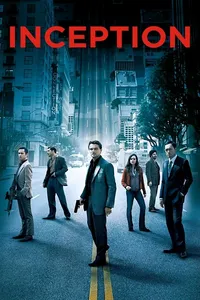
“Inception” didn’t get me at first. Cobb (Leonardo DiCaprio) has washed up, face-down, on a shore. Japanese mercenaries know, immediately, to pull up his jacket and expose the handgun in his waistband. He’s hauled in before Their Big Boss. He attempts an information robbery, within a dream. A beautiful woman foils him. Everything collapses. It all seems like a lot of sound and fury, until the plot moves to Paris, various experiences are revealed as dreams, and student Ariadne (in Greek myth, the babe who used red yarn to help a hero find his way out of a maze, played by Ellen Page) enters Cobb’s entourage, whose job de jour is offered by a man who can clear Cobb’s unfair murder charge back in the States. Everything looked like it was about to play out with effects, explosions, and a Shyamalan drop of intrigue, sufficient enough for the barely cerebral.
No. This is a dream movie. And not just in the literal sense.
Post-exposition, the execution of this heist — again, within dreams of billionaires who have had special training to resist dream insurgents trying to steal their secrets (extraction) or plant disabling ideas (inception) — ended up being “Wizard of Oz”-level amazing, where a fantastical dream about evil and love and loss goes deeper, and darker, until when you wake up — and it’s been only a five-minute nap in which you’ve lived lives, and seen worlds, and succeeded in adventures, and battled enemies — and look around you at real people and random strangers, you want to collapse in tears on all of them. “And you were there, and you, and you too.” Try to explain that, in your own dream processes, in the seconds after you wake up in which your dreams haven’t slipped away into incoherence. “Inception” is not only the rare movie that lacks any weakness, it is the most
successfully ambitious project on the screen in years.
Better than Brad Pitt, Mark Wahlberg and Justin Timberlake combined, DiCaprio has embodied the reluctant dreamboat, gorgeous but for the tortured slice of pinched brows his face allows, the grinding gears behind his eyes, two pools of stoned, sexed-up Tahitian blue. “Inception” will, thankfully, banish the clever “Juno” to the dustbins of sleepovers with VH1 in the background for the tremendously formidable Page.
I’m told “Inception” had a $100 million advertising budget, but it’s escapable. You don’t have to go to a movie knowing anything more than your friends saying, half-breathlessly, half-enviously, “God, that fucking blew me away.” Diving into a movie blind, naked of hype, is the only way you’re going to jump at the killer freight train chewing up the Manhattan asphalt; the only way your jaw will drop at the beautiful mother’s high heel slipping off, from the balcony, testing her dive, because she thinks life is a dream and she misses her children in the “real world”; the only way that red-faced, terrorized, helpless scream of the man who watches her is going to seem
heart-wrenching.
But on a level that doesn’t have anything to do with audience enjoyment or box office returns, “Inception” will obviously do half of what Cobb says about the concept of inception, in the movie, about ideas being “resilient and highly contagious.” It will be resilient. It’s taken the classic architecture of science fiction, action, drama,
love and horror, and bent it in upon itself, to marvelous, heart-suspended-without-gravity effect. Highly contagious, however? Most other filmmakers who want to be inspired in the same way, well, they’re just going to have to keep dreaming.
Ashley O’Dell writes about movies that aren’t in theaters anymore.