Inglourious Basterds
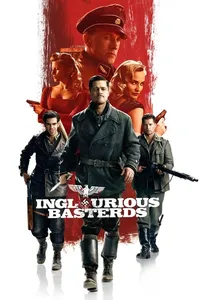
Two hours into “Inglourious Basterds,” the fun starts. The biggest World War II Nazis are assembled in occupied Paris to watch a propagandistic film about a Nazi war hero who shot 300 men in three days from a bell tower in Italy. Suddenly, a second film has been cut into their climax. It’s a tight focus, close up of a beautiful, angry woman’s face: “I have a message for Germany. That you are all going to die. And I want you to look deep into the face of the Jew who’s going to do it! My name is Shosanna Dreyfus, and this is the face of Jewish vengeance.” There are screams. There are gunshots. Americans burst into Hitler’s private booth, knock him to the ground and repeatedly machine gun his face to the consistency of shredded bologna.
Hell yes, it’s a darkly satisfying scene.
Of course, there’s the matter of those first two hours, past the clever opening sequence’s five fonts, past the even cleverer musical stylings and mostly past a vast assortment of characters with clever nicknames who all explain the exploits that earned them those names.
And Brad Pitt. Pitt is not pleased in this film. You can see it in his eyes, from the start, that lack of glint, of fun, of Tyler Durden intelligence or Pikey intensity or “12 Monkeys” insanity. Perhaps, he was told, like the audience, that a movie named for this group would focus on them — Jewish guerillas behind enemy lines, fueled by the desire for revenge against their people, learned in Pitt’s questionable Apache war techniques, such as scalping and carving swastikas into survivors’ foreheads. I wouldn’t be pleased either, if master Tarantino could only come up with post-scalping dialog like, “You’re getting pretty good at that.” “Well, you know how you get to Carnegie Hall, don’t you? Practice.”
Instead, most of the film focuses on Shoshanna, a now-grown up French girl whose Jewish family was killed by Colonel Hans Landa. Landa shows back up when Nazi war-hero-turned-film-star Fredrick Zoller falls for her and wants to premiere the movie in her small theater. Shoshanna and her secret black boyfriend Marcel decide to set their collection of flammable nitrate films on fire and lock the prominent premiere-attending Nazis in the burning theater.
The Basterds, meanwhile (remember them?) are working on a parallel plot for some reason, even though they’ve been doing their best work ambushing Nazis in the forest and not pretending to be able to mingle with officers at film premieres. When they must do so, it’s agonizingly poorly planned. Brad Pitt’s Italian accent is on par with Will Ferrell doing George W. Bush speaking Spanish, though what kind of a judgment call that is is up to you.
Speaking of judgment calls, let’s talk money. “Resevoir Dogs,” “Pulp Fiction” “Jackie Brown” and “Kill Bill” cost as much as episodes of “Friends” and “Lost.” In 2007, Tarantino landed $53 million for “Death Proof,” the kind of low-budget slash-sploitation movie whose creators would have salivated for the $7 million budget “Jaws” got. “Basterds” got $70 million.
What did that money buy? Dialog in French and German, full of cliches, devoid of pop. A Bowie song, and one by Billy Preston too. The full feature the Nazi audience came to see, “Nation’s Pride.” A Guy Ritchie-like three-second cut-away from Goebbels’ polished, Bettie Page-like interpreter, where he’s got her bent over doggy-style. And, apart from a glorious finale of revenge pornography, a slightly hollow feeling that Tarantino’s let himself become facile.
Right before the SS get schwenker-grilled in the fifth chapter, Shoshanna turns down the amorous Nazi film hero, saying: “Are you so used to the Nazis kissing your ass, you’ve forgotten what the word ‘No’ means?” Far be it to compare Tarantino’s film-making entourage to Nazis, but perhaps the ass-kissing thing might apply. Tarantino could have surprised us all the way through, rocked the war movie genre in ways so unexpected that his decision to bring back John Travolta from Hollywood obsolescence would look obvious in hindsight. Instead, at the end, one final swastika gets carved into one final Nazi forehead.
The final line of the movie, spoken by Pitt, is: “I think this just might be my masterpiece.” No, Quentin, it’s not. You used to be practiced in sweating and working and hungering to prove yourself. Recently, you’ve become practiced at being royalty. Perhaps you need to remember which was the most important.
Ashley O’Dell reviews movies that aren’t in theaters anymore.