Inside Job
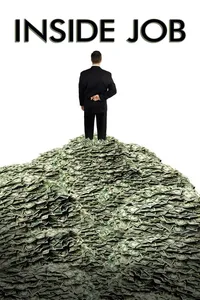
Most people call what happened in September, 2008, a bursting bubble. I don’t think that’s accurate at all. When everything hit the fan, the haves grabbed theirs and left the feeble to scrabble in the dirt. When a bubble bursts, everyone gets splashed. That’s not what happened here. What happened in the global economic crisis, or Great Recession, or Near-pression, or what-have you, was something else. It was a game with no rules but greed.
I grew up on the border. I know a piñata when I see one.
“Inside Job” lays the story out that simply, only not in my terms. The way I’d describe it is this: big, strong kids
were in the same game as the little kids, but the big kids felt no qualms about peeking out from under their bandana. When the piñata cracked open, they didn’t just grab what their hands could hold — they filled their shirts. And then they had the nerve to ask for goody bags.
So as not to overwhelm its audience, “Inside Job” starts out small and unfolds, fractal-style. It starts with Iceland, a model society until deregulation allows global companies to exploit the country’s natural resources. Newly privatized banks each borrowed way more than was prudent and collapsed. Unemployment tripled. After Iceland, we move on to the U.S.A., and how we aimed ourselves straight at a similar catastrophe over three decades of similar deregulation, which allowed the markets to gamble, both with investments and with Frankensteinian financial creations.
Written and directed by Charles Ferguson, it’s a jaw-dropping film. Good thing, too, because you might want to throw up after you watch it. But it begs the question — why allow the few fat cat bankers to profit off capitalism until their businesses, too big to fail, have to be supported by the sacrifices of the many? Why don’t people riot in the streets when they see salaries in the financial sector climb a 45-degree trajectory while most other industries stagnate or go down? Why does Columba Ramos, the face of the housing crisis, just a woman with a family and a mortgage who is underwater, not join with the millions of others like her and hunt down like dogs the investment bankers who publicly said “buy” while in private, warning against “piece of crap” investments.
The answer would take up an entire other movie, but maybe it’s this: Americans are not known as placid people — except when it comes to the rich. When we hear about a small-town thug holding up a convenience store for $40 and a case of beer, we’re outraged. But when millions lose the savings and housing equity they built up carefully for years because professionals gambled with it, carved it up, spent the excess on hookers and blow, then insured their own risks against carelessness, we blame those average Americans — not the bandits who were roiding up with our retirement funds. Partly, we want to trust the professionals, even if they are Ponzi scheming us on a massive scale. We say, ‘Hey, if we were so smart, we would have become investment bankers and derivatives traders too. We just weren’t as smart as them.’ And partly, no one wants to be accused of socialism, class warfare, discouraging ambition, encouraging the specter of Soviet Russia to take hold in our bootstrap-pulling, gumption-rich nation. “We got ours,” goes the refrain of the rogues in “Inside Job,” “so go screw yourself.”
This, of course, is what those jerks in “Inside Job” counted on — the ones who take home tens and hundreds of millions in bonuses after creating real weapons of mass destruction in credit default swaps and collateralized debt obligations. And they will steal and horde and hide like the most paranoid pirates until the common man demands they too share in the pain they’ve created. But the common man won’t do so. We’re decent. And we dream. As the character John Dickinson said in the musical “1776,” “Don’t forget that most men with nothing would rather protect the possibility of becoming rich than face the reality of being poor.”
We might all be in a better place, if only the other gambles of the last 30 years had been as sound as that one.
Ashley O’Dell reviews movies that aren’t in theaters anymore.