Jack Goes Boating
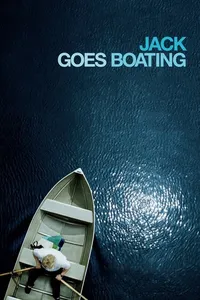
The titular character in “Jack Goes Boating” spends less time plying his oars in the Central Park lake as drifting comfortably in a numb, liquid womb of dinner parties, cassette tape reggae and warm chlorine. Jack (played by Philip Seymour Hoffman, who also directs) is an aging overweight limo driver with white-blond half dreads clamped down by those stiff old plastic Walkman headphones no one’s worn since the ’90s.
Boating would be a high-speed, guns-a-blazing car chase for this movie. But instead, there’s a lot of wine pouring, a lot of people who have Manhattan figured out to the point that they can tool around in limos and live expansively in huge apartments with views and still have money leftover for expensive hash, sold in grams, and octopus-like hookahs to smoke it out of. Jack’s friend, a long-term married dude, sets him up on a blind date. His date, Connie, is a third of his size (it’s Amy Ryan, who plays Holly, Michael Scott’s love interest, in the American version of “The Office”) and there’s no reason she should like him, but hey, this is the land of bloated, not-trying-anymore men who land sparkling-eyed, fit, thin, dewy-skinned ingenues. For no reason, except perhaps an imaginary, stage play-like sense that they might be able to mumble out a few heartfelt lines.
Writer Robert Glaudini, in his first effort, has figured out how to write down strange fragments of modern conversation, like the daughter of a former hospice patient talking about “the coma room,” or Jack’s friend’s wife calling a grief expert “the death guy.” These are cutesy details, and they don’t overcome the recoiling disgust that ripples throughout the script when it comes to people’s relations, the friend telling Jack that as soon as anything tarnishes the innocence of his new relationship, “you will have vivid images, and know that they will recur probably forever.” Like, who says that?
“Jack Goes Boating” is as disappointing a movie as Jack should be to Connie. She grins and bears it. We shouldn’t. Hoffman’s Jack makes “The Big Lebowski’s” Dude look positively action hero material. Connie’s not much better. She’s a lovely woman, but she provides the same services as a prostitute, just on less of a schedule and for no price. “You can stop if you want to,” she tells Jack as he touches her. Then, trying to mold herself to whatever he wants, she says, “What do you want to see in a woman?”
And despite these gruesome depictions of bloodless human relations, when Glaudini attempts to create tension, passion, the necessary irritation of love between his characters, he’s mute. He makes a man attack Connie on the subway, giving her a blood-gushing face and a few fractured ribs as she sits at her desk, trying to work. Jack’s inadequacies can be fixed by, can you believe this, lap-swimming lessons and cooking classes. Connie’s big scary admission? She has a sexual fantasy that involves a man in space. Their hearts may pound with these efforts, but like other recent crummy, sludgy, boredly bourgeois efforts like “Please Give” and “The Kids Are Alright,” there’s nothing to make the audience’s supposed to do the same.
There’s a part, early on in the movie, where Jack’s friend parks his limo outside of the Waldorf to use the bathroom. He is chagrined when he tries to pay the attendant in coins. As he leaves, he slows, then stops, then enters a formal event in one of the hotel’s ballrooms. For a second, we think we’re about to see the moment where he changes, where he takes some radical path that will show him why complacency is death. He walks away. He doesn’t take the opportunity. Neither does the movie.
Ashley O’Dell reviews movies that aren’t in the theater anymore. She lives in North Hollywood, near the In-N-Out Burger.