King of California
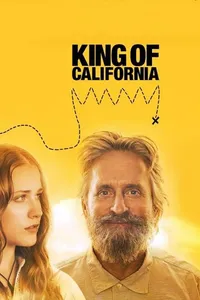
Almost 16-year-old Miranda (Evan Rachel Wood) has warily reunited with her father, whose brain is made of equal parts Charlie Mingus and Don Quixote. Mom, a hand model, is long gone. Dad (Michael Douglas) or “Charlie,” to his daughter, has been a ward of the Santa Clarita Department of Behavioral Health for two years. He’s used his time researching a legendary Spanish treasure — and he thinks it’s just one father-daughter treasure hunt away. Miranda’s not exactly keen on the idea. While Dad’s been dreaming, she’s been scraping by working double shifts at McDonald’s and keeping up the old, paint-flaking family home, whose surrounding orange groves have been eaten up by little pink ticky tacky houses named for the trees and wildlife they displaced. (As Wood notes in voice-over, after finding a startled bobcat hiding out from the rain in the kitchen window, “animals were popping up in unlikely places. One woman said she saw a deer in the cosmetics aisle at Target.”)
See “King of California.” It’s worth it to see the last scraps of California eaten up by surveyor’s orange tape — the last 3.75 acres left from the early 20th century, the kind of beauty that, even second-hand, would make you throw your family in a horse-drawn carriage in Oklahoma and hope you had enough hardtack to make it to the coast. It’s worth it for the slow-motion leers and jiggles of a suburban barbecue, set to the adult contemporary chloroform that is Seals and Crofts. It’s worth it for the flashback scene where a young Miranda, guided by her dad’s love of esoteric history, shocks her teacher, Wednesday Addams style, with a diorama depicting California’s Chumash Indians massacred by the exposure to missionaries’ influenza and smallpox for three centuries. It’s worth it for the elbow in the ribs of Conspiracy Theory, like when Douglas’s character insists he’s found pottery shards. “Feh!” he says of radio carbon dating. “FEEL how old that is.” Evan Rachel Wood and Michael Douglas aren’t trying to play father and daughter. They’re playing young, damaged, strong woman and a helpless, dependent, mentally ill loner in the body of a father who says he’s trying to find the treasure to find “if I exist.”
“I don’t want the money,” he tells his daughter. “That’s easy for you to say,” she responds. “You don’t have to work for it.”
The one bitter gloss-over of the movie is that Douglas’s character is a one-sided portrayal of madness — you chuckle when you see him sweet talk a policewoman when he’s trespassing on a country club golf course, but that’s because you never see him waking Miranda up in the middle of the night afraid he’s being stalked. You can stand Douglas because he takes home that policewoman later, and Miranda walks into a few seconds of awkward aftermath after their one-night-stand — but you never see Dad screaming at 3 a.m. that the CIA is watching him. There’s a macabre flashback where Miranda saves him from taking his own life. Perhaps more of that was snipped out, for our delicate sensibilities. Perhaps someone thought it would make the movie ride better, hard truths be damned.
Cyril Connolly said “our memories are card indexes consulted and then returned in disorder by authorities whom we do not control.” Even if that’s true, it’s no excuse to make your daughter, the one whose birthday you can’t remember, wash all your dishes and take the bus because you sold her car. There are plenty of people like Douglas in real life. He sits around in pajamas stroking his beard and daydreaming about Spanish explorers squirreling away their gold bullion in a heaven-lit oak filled valley in Southern California. Others call in sick to work for weeks, claiming they got the spinach salmonella, the peanut butter e. coli or the KFC bird flu when all they really have is don’t-wanna-itis. Exercising some glorious wild flinging away of all responsibility isn’t inspiring or freedom when someone else is picking up after you — especially your daughter. The vast majority of these people would make passable episodes of “Intervention” and horrible movies.
Still, “King of California” has a clear and cutting view of American development as invasive species. The two lead actors, who may be connected by a tenuous spiderweb-thin bond, but care about it enough to safeguard it from breaking. Even if Douglas was given an incomplete character from the start, he never lets us think that’s true. The movie’s worth watching for that and for Evan Rachel Wood’s stare. It’s a stare that says to Douglas that if he leaves her with nothing else, he’s leaving her with the lesson to be the opposite type of parent he is. And sometimes, that’s the best, and only, thing a disastrous parent can leave their offspring with.