Paper Moon
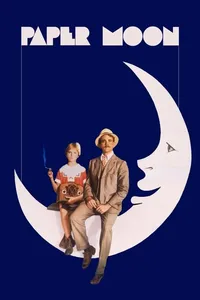
Flanked by two women, a 9-year-old girl with inelegantly cropped blonde hair stands at an open grave on the windswept prairie of Kansas at the start of “Paper Moon.” As the preacher intones over the hole in the ground, a handsome man in a backfiring jalopy appears in the distance. He gets out. He’s late. He grabs flowers off another grave.
“Amen, Essie Maye,” he whispers, as the small group moves away to drink from a rickety pump. “l just know your ass is still warm.”
Who is this guy? No one really knows - but he’s got the same jawline as the girl and he’s heading to Missouri, coincidentally, where the little girl’s only known relative lives. The women chirp gleefully and put her into his care.
Moses “Moze” Pray (Ryan O’Neal) isn’t the gee-shucks Christian man he’s made out to be - but little Addie (Tatum O’Neal, his real life daughter) isn’t an innocent orphan, either. In too-long, rolled up overall pants and a tight, elaborate hat, she’s a savvy creature who eavesdrops as Pray drives her to a dismal agricultural plant run
by the man, we learn, whose brother killed Addie’s mother in a drunken driving accident. Moze wants a payoff. And Addie, not so easily put on a train when some strange man has just pocketed money to keep quiet about her mother’s death, wants one too.
“You meet my mama in a barroom?” grills the little girl whose worldly possessions amount to a radio and a Cremo cigar box. He tries to avoid the question. “You my pa?”
He denies it, falling right into her trap.
“Well then, if you ain’t my pa, I want my $200.”
Moze mulls it over, but soon discovers something that connects the two more than a jawline - a talent for fraud. He’s got a stack of Bibles in his back seat. A fresh newspaper obituary column. And a printing tool that puts widows’ names, in “child of the manger” gold letters, right on the Bibles their husbands ordered right before they died … all still in need of the $11 final payment.
Addie scowls from Moze’s car as she figures out the scam. You can see her brain working that night, smoking a cigarette like a little gargoyle in bed as Moze thrashes in a pile of bad rugs on a motel floor. At the next visit, where the widow is accompanied by a suspicious, imposing man, she rushes in for the save, telling her “daddy” that they’re late to “pray for Mama,” and telling the surly man the Bible costs $5 more than Moze was trying to get for it.
In the car together, staring ahead at the bleakness, they actually smile. Addie’s not just a firecracker. She’s an M-80. At one point, when Moze picks up a girlfriend - the always splendidly batty Madeline Kahn - he admonishes Addie, “Little children don’t tell grownups what to do!” Addie doesn’t have to say anything to contradict him. She knows she’s in control.
The crackling “Paper Moon” bears quite a lot of similarity to another tale of a man and a young child thrown together and scrabbling (and scamming) for survival - Charlie Chaplin’s 1921 classic “The Kid.” Both are gritty movies that aren’t afraid to let the children be gritty - rare - but neither one turns the central child into a too-cold, too-hardened bipedal version of a feral dog, as newer movies like “Pan’s Labyrinth” and “Let the Right One In” did.
As with “The Last Picture Show,” Bogdanovich’s 1971 classic about the differently desperate lot of small town Texas teenagers in the early 50s, “Paper Moon” draws a sense of tenuous, amazing survival out of the grim landscapes and bad roads, the scratchy squall of old music and clattering cars. It should be soaked in and watched raptly - and repeatedly.
A movie about happiness doesn’t have to be happy. Maybe it shouldn’t be. A man squabbling about his possible paternity, a girl disrupting a diner - Walter Sobchak-style - and demanding money with food in her mouth, the two running after a rusty car as it careens down a road toward an uncertain future - these scenes can still evoke love, even a tiny jot of protection. It might not be the cuddly, comfortable version we’re used to seeing on the screen, but, like “The Kid,” it’s arguably a better form of it.
Ashley O’Dell reviews movies that aren’t in theaters anymore.