Parents
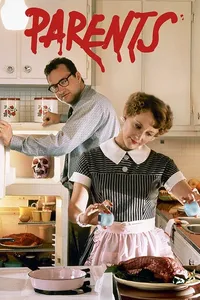
How strange would it be to be a cubicle dweller in Showtime’s marketing department whose big break comes during a late 80s encounter on a plane with actor Bob Balaban? That’s what happened to Christopher Hawthorne, IMDb tells me, when he met the “Catch 22,” “Close Encounters of the Third Kind” and later “Best in Show” and “Ghost World” actor and showed him his bizarre little gem of a script about a boy in the 50s who discovers his perfect suburban parents are cannibals.
More bizarre might be that Balaban seized on it, and decided to direct.
“Parents” (1989, rated R) is a wonderfully weird, sort of liberatingly terrible piece of work that, like a psycho itself, seems sometimes more interested in spiraling back towards nightmare sequences from the brain of proto-vegetarian Michael (played by Bryan Madorsky, who seems to have had enough of Hollywood after this experience) rather than getting us somewhere typically big and brash and Hollywood at the end. Balaban’s sole acting direction to the boy might have been: “You’re so repulsed by what you believe your parents are eating that you don’t even have the energy to projectile vomit anymore, son.” So while he wanders, wan, through their picture-perfect split-level mid-century home (the kidney-shaped decor a clever nod to the theme of the movie) it’s in contrast to Dad and Mom (the just-shy-of-crazy Randy Quaid and amphetamine-perky Mary Beth Hurt), who are as chipper as the period tunes on the soundtrack (“Chantilly Lace,” “Purple People Eater,” “Meatloaf Mambo” by David Lynch music man Angelo Badalamenti). Dad, who just got a new job at Toxico (hah!) is seen describing to his wife how “defoliants are a growth industry!” after the family’s finished a locomotive-sized dinner of “chops,” vague meat slabs, semi-fatty, semi-bloody, splayed out on a huge platter. That night, Michael goes to bed and has a nightmare that he’s leaping into bed onto a bedsheet covering a huge basin of blood. Finally, the camera pulls back from his thrashing to reveal that it’s day, and Michael is poking at a real bowl of blood as his mom defrosts ever more meat.
For most of the movie, the possibility remains that our young hero is just traumatized by moving to a new home and is letting his little imagination run away from him; he does, after all, act out in class, one-upping the other new girl’s show and tell (“if you add an onion to a martini, it’s called a gibson”) by describing an Arthurian myth about how chewing on the bone of a broiled, skinned black cat can render one invisible. Another time, he tells his mom they wouldn’t have to heat their home with gas, as hanged people with chopped off hands “burn forever.” And that’s before the central scary scene of the movie, where Michael sees his parents late one night, sweaty, in their underwear, smeared with — lipstick? Blood? We won’t find out until the end, but whatever happened, it’s enough to manifest in a creepy school family portrait that gets the attention of the school social worker (Sandy Dennis).
At about an hour and a half, “Parents”’ sick trip lasts a little too long, and without much narrative arc, aside from the mystery of the meat. We don’t really find out much about how it relates to Dad’s work at “Toxico,” or what happens to the people who, surely, must have come around wondering what happened to their missing loved ones. But I love the fact that this movie was made, and, apart from some of the “modern” visual effects (Michael running in black and white slow motion down his hall, a montage of his parents sexily eating a victim) the special effects are wonderful, whether goofy (a shelf of sausages creeps, python-like, to strangle Michael as he hides in a pantry) or beautifully disturbing (a thrashing, bloody hand reaches out of the garbage disposal and whips around crazily as a sheet of perfect red blood pours slowly over the perfect refrigerator) — especially ending as that scene does with Mom chirping, “Rise and shine!” Even with camp levels at near Pee Wee Herman levels, this is the kind of movie that makes people upset — very upset, and very disturbed, and very, very offended, not just at the subject matter but also at its combination with that so-called golden age of America. Setting “Parents” in the 50s may seem like juxtaposition on the surface, but on a deeper level, perhaps the level that would really tie someone’s panties in a bunch, it shows that something like suburban cannibalism almost fits too well with the cheery sparkle and clownlike rictus of the decade. When you can prompt that kind of myth-busting with a movie that features sausage puppetry, it just makes the whole thing so much more enjoyable. And like a fine meat, “Parents” has aged exceedingly well.
Ashley O’Dell reviews movies that aren’t in the theater anymore. She lives in North Hollywood, near the In-N-Out burger.