Pontypool
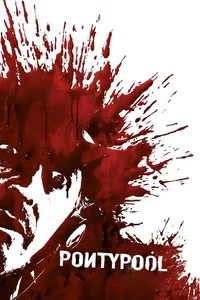
I promise that this review has not been influenced by the fact that Netflix hit some kind of weird Internet frost-heave at the end, resulting in the last 15 minutes being viewed on YouTube, with German subtitles.

Because, stoppage or no, the whole movie had been a great low-budget big-imagination take on the typical zombie apocalypse discovery genre. A skeleton staff at a news radio station in Ontario starts hearing reports of townspeople acting bizarrely — smacking on people’s car windows, pouring like an explosion of cockroaches out of a local doctor’s office, even seeming to eat each other, if their not-quite-in-a-helicopter traffic guy is to be believed. We don’t see any of it, but from the fragments, we can picture it so well, just like the conflicted characters in the radio booth, who wonder if they’re being pranked, a reversal on the Orson Welles “War of the Worlds” broadcast of almost 75 years ago.
Director Bruce McDonald (read my review of his film “The Tracey Fragments” here) keeps things tense and interesting and original up until the poison pill that slowed down my enjoyment far more than the spinning “loading” indicator: The High Concept. Here’s how I looked when the movie unveiled its cute little explanation for why everyone in its Ontario town was getting all dumb and shambling and bloody and chompy:
We call this awesomeness “The Sharon Needles.”

Station employee Laurel-Ann, a recently returned Afghanistan war vet played by Georgina Reilly, a thinking man’s Kristen Stewart, got shafted on this role. Here we are, in a dark, secluded Ontario radio station with a cast of three — aside from Laurel-Ann, there’s shock jock Grant Mazzy (Stephen McHattie) and Sydney Briar (McHattie’s real-life wife, Lisa Houle) and we’re all receiving the same second-hand reports that Ontario is under siege from zombies. But Laurel-Ann’s combat skills are for naught, and she unfortunately becomes the movie’s first red shirt casualty.
Sorry, The Hyena Dog Robbery, but I don’t trust any band that can’t make criminally scrappy posters.
Fine. I’ll accept it. Sydney and Mazzy can carry the rest of the movie. And they do, bouncing off each other — Sydney with her professional instincts smacking down Mazzy’s cheap desires to infuriate people even if he has to make up phony resolutions to actual news reports. That is, until the aforementioned doctor arrives at their office and turns into a living embodiment of The Plot. (As Stephen King said in his book “On Writing,” “A strong enough situation renders the whole question of plot moot. The most interesting situations can usually be expressed as a What-if question.”)
As in, “What if something strange — an apparent infection — overtook a small Canadian town?” How would those in the radio booth, tasked with informing their listeners but suspecting they can do little with their power, react? Is the interesting story about the mechanisms of the infection, and why this is happening, or is it the experience of not knowing what’s going on? To me, the confusion, the being blocked off from information, the panicky sifting of information in a bizarre situation, is what we want to see. Not the medical expert bursting in to sell us an awful, loathe-yourself fantasy about how the English language has been infected by something that spreads via certain words and phrases, and the only thing we can do is channel our inner slam poets to spread vomitous haikus to heal ourselves.
“Except in very bad French!”
An explanation like that reminds us that we’re watching a movie. A movie less interested in entertaining than being highbrow. And once we’re at that point, you might as well be trying to pitch us the movie while we’re in the lobby blinking at the horrible carpets and trying to remember where we parked. Without going into the quirky fantasy, half-Tarantino, half Luhrman, way the movie ends post-credits, part of the resolution involves a monotone obituary-reading the movie started with. Except listeners aren’t hearing about 80-year-olds dying of cancer and finding out where their memorial services will be: We hear about entire young families who died at each others’ hands, and that they were survived briefly, sometimes a few hours, until they were killed by others. We don’t hear why. The distancing language of sensitive obituaries keeps the scenarios in our imaginations — where they unfold most brilliantly. In a work like “Pontypool,” that’s supposed to be the whole point, that being alone with our imagination is often more terrifying than hearing a dissected, factual play-by-play of what really happened.
Ashley O’Dell reviews movies that aren’t in theaters anymore. She lives in North Hollywood, near the In-N-Out Burger.