Powder Blue
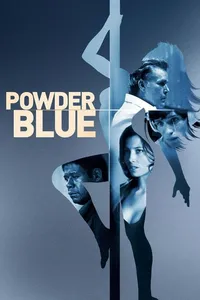
“Powder Blue” sets its themes out early — radio news reports a man with AIDS has spotted the Virgin Mary in his windshield while a corner hobo’s sign reads “In need of a miracle.” And just as early, it blows the whole thing by introducing a too-precious cast of characters in a Los Angeles unrecognizable outside of a straight-to-trailer shot of a young man racing his girlfriend down the Hollywood Walk of Fame in a shopping cart.This movie doesn’t need a miracle. It just needs some reality. Let’s start with the title, which seems to come from an ending scene in which a character is buried by a snowdrift of cat-litter-crystal-blue ice.
Unlike “Magnolia,” another So Cal-centric movie about a cast of malcontents united by a strange weather event, “Powder Blue” is fatally wounded by a profound disconnect in the way people — even fictional movie people — are supposed to act. Most of it springs from writer/director/producer Timothy Linh Bui’s view of women, who in”Powder Blue” are sexy, forward and met with revulsion. Whether it’s leading lady Jessica Biel (as “Rose Johnny,” who only strips to pay her comatose son’s hospital bills … and so she can buy coke) being turned down by a man who’s taken her on a date or weary widower Forest Whitaker turning down flirtatious diner waitress Lisa Kudrow, it’s senseless.Whitaker, by the way, has a bag of money — we don’t know from where — and he wants to give it to someone who’s willing to kill him. But two random encounters, a pre-op transexual (the beautifully expressive Alejandro Romero) and the scrawny young hearse driver whose dead dad’s house is about to go into foreclosure (Eddie Redmayne, who needs carbohydrates), can’t stand to do it. (The hearse driver, by the way? His name is Qwerty, as in the keyboard sequence. Does it have to be so obvious when writers don’t care?)
Not strong enough to have merely one financial benefactor plot crutch, “Powder Blue” has two. The second is Ray Liotta, an ex-gangster who Kris Kristofferson gives a briefcase of cash in the opening scene for keeping quiet during his jail time. (We don’t see Kristofferson again, which is good because, appropriately for someone who can be out-manned by Barbra Streisand on an LP cover, he makes a lousy gangster.)The sad thing is, we don’t care who either sugar daddy helps out. Some of “Blue Powder’s” characters are given a few stellar seconds. Liotta, flush with cash and freedom, hires a demurely lit Biel for a private dance and clings to her, not with lust, but like an almost drowned man grasping at air. And on the stage, Biel’s sad, stylized pole-dancing is actually the farthest thing from “Showgirls” — she struts to ponderous chanteuses like Cat Power and Imogen Heap instead of flipping and jerking to ’80s hair bands. Maybe it’s because she doesn’t talk during these scenes, but Biel pole-dancing is the most truly enjoyable part of the film. Especially compared to her sceneswith the smitten Redmayne, with whom she has to exchange the following dreadful dialog:“I’m going to count to three and we’re both going to stand up and we’re going to hug each other. Can we do that?” he asks.
“I’m a single mother with a kid in a coma and I make my living by taking my clothes off. I’m a klutz and I spill everything,” she blurts.
“I work with the dead,” he counters. “I play with puppets. I’ve never had a real girlfriend in my life and I get nervous around people, which triggers my asthma.”Then, she has him promise her that “when tomorrow comes, everything’s going to be OK.”That big theme of sun’ll come out tomorrow, miraculous redemption just never comes through like Bui wants it to. Early on, Whitaker flashes back to a home movie, shot in his car, with his bride on his wedding day. We later find out that he left the priesthood for her and that the home movie ends in a car wreck — because he took the handycam from his bride to film her. The widower Whitaker ends up, tortured, in his former church, moaning that his only sin was love. No, man, your “sin” was that you shouldn’t have been trying to shoot video and drive a carat the same time. Neither the sin, nor the movie, comprises much more than that.
Ashley O’Dell reviews movies that aren’t in theaters anymore.