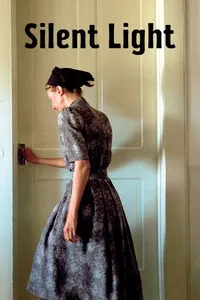
Silent Light
In 1964, Andy Warhol aimed a camera at the Empire State Building, filmed it for six hours, then slowed down the frame rate to stretch it to eight hours, called it “Empire” and wouldn’t let anyone screen an abbreviated version of it. Certain people think it’s pretty nifty that at one point, when he changes reels, you can see his reflection for like a second in the windows. Yoko Ono did a bunch of “films” like this — single shots of naked butts, or of John Lennon’s penis just sitting there. Warhol was messing around. Ono and Lennon just did a lot of heroin.
Mexican writer/director Carlos Reygadas’s “Silent Light” elicits a similar feeling after the first few minutes — utterly tricked.
After endless minutes of darkness, the noise of crickets, birds and faraway farm animals as dawn breaks, the movie moves to the breakfast table of a farm family — Prussian Mennonites in northern Mexico, though unless you know that going in, it’s easy to sit there in the silence with them trying to figure out if they’re speaking German or Norwegian or if we’re in Sweden in the summer or what century it is.
The camera watches a clock. The family spoons in their cereal. The father bursts into tears. One knows not why, but suspects it has something to do with the lack of a coffee pot.
About 22 minutes into the film, the camera creeps toward a mechanic’s barn at the pace of the sloth-like slow loris. (The zoom feature doesn’t always have to zoom, but come on.) Outside, the father chats to another man about engine cleaning — oh, and that he cheated on his wife. Things do not pick up from here. We watch the back of the man’s shoes shuffle up a flowery hill, where at the top he makes out with a woman. The scene changes and the camera closes in, eventually, on someone showering. Another change, and the children, bright-eyed but the kind of creepy quiet usually only achieved through school-insisted heavy medication, splashlessly bathe in a perfect rock pool in the middle of a glade, then lay quietly on the grass and stare at the leaves of the trees. When they disappear off screen, the camera drifts until it focuses on a pink flower. One is supposed to marvel at the use of a shallow depth of field, but it’s tempting just to yell “focus!”
The film then floats through similar scenes: men driving trucks, cows going into a shed to be milked, a sudden time-jump in which it’s snowed out, a brief conversation in which the man’s father tells him adultery is a sin. By the time we get to a shot of a combine trundling through a field, the action-packed harvesting and threshing might as well be a high-speed car chase over a broken bridge with a velociraptor giving chase in a hijacked cigarette boat.
What’s most frustrating is that this rarest of subjects is spoiled by the director’s so-obvious presence. Ironically, his silent, slow, foreign storytelling gets completely in the way of the silent, slow, foreign life of the story. It’s like Reygadas thinks that Mennonite life is some slow, meditative art scene, saturated with meaning, something to be crept up on like a jungle explorer parting the fronds on a hidden civilization — and never realizing how hard it is to marvel with those hands constantly in the way.
You want to see an awesome movie about societal outsiders dealing with rough times? Go rent Craig Brewer’s “Hustle & Flow” (2005, rated R).
Both movies have the same thread — “it’s hard for a pimp / But I’m praying and I’m hoping to God I don’t slip.” But unlike Reygadas, Brewer, to his massive credit, never treats his prostitutes and aspiring rappers like museum curiosities.