The Hurt Locker
Our post-9/11 wars continue, and even with our noses remain collectively pressed up against this monolithic thing that is conflict, filmmakers continue to figure out what the genre of Iraq War Movie means.
Kathryn Bigelow, the director of “The Hurt Locker,” which is based on a story by embedded journalist Mark Boal, smartly does not attempt to predict the plot arc of an ongoing event, especially the “why” of it all. What she shows us is that maybe there is no why — not yet.
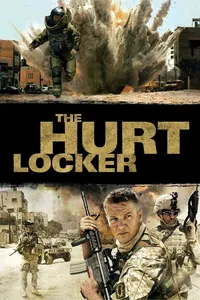
In the opening scene, bomb-tech Guy Pearce is killed by a gravity-suspending IED. The force of the explosion lifts the pale sand and rocks from the street like dust off a snapped bedsheet. Charred flakes of paint and dust float off a burned out car. Blood splashes against the clear front of Pearce’s astronaut-like bomb suit helmet. We don’t consider bomb techs much, but then again, we don’t really consider the war. There’s death, but not at Vietnam rates. There’s a vast committal of resources, but we’ve left conservation to the hippies. There’s distance, but not only can we not now see an end, we can’t even imagine one. Men willing to fly planes into buildings, hide bombs in the tortured cadavers of little boys, strap cages of explosives to fathers, enlist children to hide shallowly covered bombs along the roads. Only one of these elements can be easily understood and defused.
That’s what “The Hurt Locker” is about — picking through Iraq one spiderwebbed explosive at a time, documentary style, sink-or-swim in the jargon and the pace. It’s easy to see the job of bomb disposal as fatalistic, suicidal, thank goodness someone else’s spouse or child is doing it, not mine. Turn the task around, though, see it as something that can be done precisely, an equation that can be solved in a world where the only thing you can trust is that you can’t trust anything — children on a balcony or concealing trash on a street — and there you have the drive of Staff Sergeant William James, Sergeant J.T. Sanborn and Specialist Owen Eldridge.”The rush of battle is often a potent and lethal addiction, for war is a drug,” is the quote, from a book by war correspondent Chris Hedges, that opens and is the thesis of “The Hurt Locker.” James, Sanborn and Eldridge are each at different stages of being gripped by this rush, with its accompanying persecuting cynicism (“Aren’t you glad the Army has all these tanks parked here? Just in case the Russians come and we have to have a big tank battle?” Eldridge asks) and outlets (“Gears of War,” cigarettes, heavy metal).
It’s easy to contrast “The Hurt Locker” and “Avatar” because Bigelow and James Cameron used to be married, but the two movies have as little in common as Pixar’s “Cars” and Stephen King’s “Christine.” Yes, there’s been a lot of laudatory, thoughtful attention paid to Bigelow’s movie, but it pales next to the huge, overwhelmingly positive response to Cameron’s soft, safe, childishly reductive rainforest ride.
However, this helps put “The Hurt Locker” in the necessary homefront context.
People have famously fallen into depressed states upon leaving Cameron’s lush world of phosphorescent flowers. In “The Hurt Locker,” at the end of Bravo Company’s rotation, James is home again, paralyzed before a mile-long aisle of cereal in the grocery store, shocking his wife into wordlessness when he tries to talk shop as they prepare dinner, soaking in a sad disconnect before his infant son, joyfully batting a mobile. The Vietnam-era “spitting on veterans” trope is long-squashed, but that lack of understanding still plays out every day when people suggest dealing with street criminals by sending them to Afghanistan or Iraq. “Thank you for your service,” we say, while in the same breath suggesting the task is also the appropriate hole to throw the poseur teen scofflaws we read about in the police blotter. Having 50 brands of cereal to choose from is superficial. We also fall into depressed states upon leaving Cameron’s lush world of naked blue natives and phosphorescent flowers because the real world ain’t purty enough. That, there, is the septic depth of our repulsion to sacrifice.
And at the end of “The Hurt Locker,” there are answers. They’re not nice ones. They just work. Out here in America, we don’t even understand that there’s a question.
Ashley O’Dell reviews movies that aren’t in theaters anymore.