The Informers
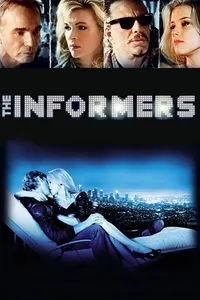
“The Informers” is an unlovable movie full of unlovable people, as incompetent as it is over-ambitious.The problem isn’t Bret Easton Ellis, a writer especially talented at eviscerating the most vacuous parts of privilege. When he’s at his best, he’s a cruel hero letting blood from a bitter 1980s vintage, as adeptly pointing out the pointless as a plastic surgeon felt-tips his way across un-tucked flesh. With a gifted team, that translates to screen, as in “American Psycho.” But mostly, his works, when translated to screen, like “Less Than Zero” tend to flatten into frivolity. “The Informers” is, by far, the worst offender yet.
The problem is that “The Informers” — a collection of short stories — was stitched into a plodding non-story of over-sexed, over-drugged, over-moneyed Southern Californians who blur together before one even leaves the first storyline.
There’s a pack of spoiled young things. One gets hit by a car: his wake is subsequently held at the Beverly Hilton. There’s a spoiled British band washing down Quaaludes with vodka, breaking things and boinking groupies. There’s a spoiled dad draging his spoiled son to Hawaii to pick up midwestern girls drunk on girl drinks named after kinds of lava. There’s a spoiled Kim Basinger, still in lust with her poolboy, reuniting with zoned-out husband Billy Bob Thornton, still in lust with local news hack Winona Ryder.
A bellboy from Barstow — the film’s one uncorrupted main character, ironically played by Brad Renfro, who overdosed on heroin after filming finished — is blackmailed by his kid-snatching uncle, Mickey Rourke, channeling Dog the Bounty Hunter with six-pack-abs, hangover shades and peroxide hair. He’s got quite possibly the worst lines in the movie. That’s saying something for a script that reads like a 90-minute transcript of cokeheads locked into philosophy in the bathroom (Choice lines include: “We’re not in the desert anymore.""Oh, I think we are,” and “I need someone to tell me what’s good and what’s bad,” and “Where’s her dad?” “On location in Italy.” “Is that supposed to be an answer?” and finally, “There’s no more sun.”) That’s the kind of setting where someone comes up with the idea to turn 13 separate stories into a linear film sympathetic to a world of perpetual childhood.
No doubt Ellis had something in his short stories, had something true and powerful hidden among the smashed vodka bottles and mirror-cut coke, had something that would keep you from wishing awful deaths from AIDS upon all these horrible, sexy blonds. Ellis’s complex marinade of love and hate for his hometown, Los Angeles, turns here into high school English cliches about booze and pot and coke and orgies and MTV. The result is as powerless as stepped-on cocaine and as pitiful as sad as mother and daughter boob jobs. Somewhere in production — as everyone scrambled about trying to spend as much money as possible on aerial night shots and hotel rooftops and Hawaiian beaches, on Porsches and BMWs and limos and Piper Cubs and about 300 pairs of immaculate black Ray Bans — the real stuff got flushed.
Ashley O’Dell reviews movies that aren’t in theaters anymore.