The Men Who Stare At Goats
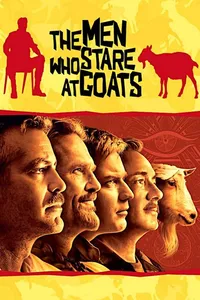
At the end of “The Men Who Stare At Goats,” a man stands up, runs across a stretch of open office space, and disappears into a wall. That pretty well sums up what happens to the movie: a great momentum, flung into the void.
With four high-wattage stars (George Clooney, Ewan McGregor, Jeff Bridges and Kevin Spacey), the movie takes the unique premise laid out in the book of the same name, about the military’s forays into “psychological operations,” (seeing if one could stare at a goat hard enough to make its heart stop) and the First Earth Battalion, seen in the movie as an excuse for soldiers to dance, talk about plant auras, wear “Om” symbol T-shirts and paint their barracks walls in psychedelic paisley like a groovy old Avalon Ballroom poster.
The book was accompanied by a multi-part series about these truly wonderful, odd topics. The transformation into fiction, unfortunately, is lacking. To fit the subject matter into a plot requires the fashioning of a plot arc, which in this case involves characters musing that they were just “looking for something to believe in,” wandering “Ishtar”-style over sand dunes, and forming significant attachments to feathers that may or may not have illusory powers. The characters throw the word “Jedi” around a lot. Yes, there are plenty of laughs, like when Kevin Spacey tries to psychically see the contents of a cupboard: This is Larry’s spirit guide, Maud,” he says in a high-pitched Ms. Swan voice. “I see … a tin mug?” There’s also a “sparkly eyes technique” (Tyra Banks calls this smiling with your eyes, or “smizing”), a part where a psy-ops soldier looking for Manuel Noriega advises asking Angela Lansbury and a “Fight Club”-like directive: “We officially do not exist as a unit. And remember, no solid food for the first week.”
But overall, neither the characters nor the filmmakers seem entirely sure what they’re trying to master.
It’s like if someone decided they were going to turn the Malcolm Gladwell pop sociology book “The Tipping Point” into a linear-plot movie. When there’s no continuity among, say, a rash of suicides in Micronesia, hipsters deciding Hush Puppies were cool and seniors getting to an infirmary thanks to a user-friendly map, to take examples from Gladwell’s book, the movie would have to create one. This is why, in “Goats,” we have an unnecessary, target-marketed subplot about redemption, plus a supposed journalist tagging around, never taking notes as he bops from one experiment to the next: breaking clouds by staring at them constipatedly, breaking prisoners by subjecting them to strobe lights and Barney the dinosaur and finally, stopping a goat’s heart by staring at him.
Though Clooney, Bridges, Spacey and McGregor give enjoyable performances, there’s neither enough style nor substance in between their best bits. The movie’s trip into the mind is too much “trip” and not enough “mind.” Its humor is flattened by a half-baked plot and a heavy-handed spirituality, “lightning-struck by the peripatetic ruminations of the Tibetan ruling class in exile,” as the late Utah Phillips used to say about a certain type of California culture.
But at least Ewan McGregor can now say he’s been in a watchable movie about Jedis.
Ashley O’Dell reviews movies that aren’t in theaters anymore.