The Secret of My Success
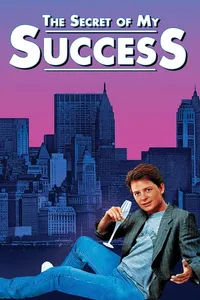
The last half of the 80s couldn’t have been better to Michael J. Fox, even as his most iconic role — Marty McFly — more than epitomized the bullied, car-less, late-to-class, mired-in-family-drama, could-be-chicken proto-person every normal teenager is inside. Not only did he have normal problems, he watched his crazy, wild-eyed oldscientist best friend get gunned down by Libyans in a mall parking lot, forcing him to gun the doc’s time machine into the 50s, then the future, then the 19th century, where he successively had to save everyone he ever loved, would love, or depended on for his DNA. Talk about heavy.”The Secret of My Success” is another such tale of a scrappy fighter working against impossible odds, except that in this case, it’s not time travel Fox’s brain is whirling to understand, but something more boggling to average citizens and theoretical physicists alike: New York City’s financial district in a time of great insecurity for the average working man.”New York City.”
“He wants to see what’s there.”
“I can tell him what’s there.”
“I don’t know how, when you’ve never been.”Those are the straight-to-camera, quick cut lines that start the movie, spoken by his parents as we cut back and forth between Brantley Foster (Fox) telling his parents he’s striking out on his own and will return a master of the universe, and his arrival in New York, which soon involves a hilariously calm conversation in a phone booth as he dodges bullets during a bodega robbery. For the cliche set up, trust me, it’s about as far from hokey as it gets.As Foster, Fox is a fresh off the bus college graduate with the blessings of his family can only hope for his best laid plans to amount to an entry-level office job and a one-room apartment piled, “Hoarders”-style, to the ceiling with trash, insects and rodents, just a crate to eat a slice of pizza and a soda on, and a nail in the wall to hang one’s shirt. If the punch line was that them were boom times in 1987, it’s got to arouse some kind of chuckle, however sad, that that scene would be a success for any number of aspiring achievers flinging themselves on the bosum of New York City now, eh?Unexpectedly out of a job because of a hostile takeover, the plucky, witty Fox reluctantly accepts his mother’s offer to contact his high-rise tyrant of an uncle (her “cousin Ellen married his half-sister’s nephew before she got bit by that dog and died”) for a possible job opening. After a day arguing with HR departments across Manhattan that he’s neither unqualified nor overqualified, he delivers a passionate plea that gets him a foot in the door — but not on the layoff-riddled floor where the windows overlook the Empire State building, but in the mailroom, where inefficient employees can take a whole morning to do a 30-minute delivery run. It’s that loophole that inspires him to commandeer an empty office.Taking on an alternate identity as “Carlton Whitfield,” the freshly minted business grad brilliantly yet believably answers frantic calls meant for the previous occupant, even as he continues his mail-delivery routine. He swaggers into executive meetings with boat-shaking ideas, even as his heart pounds in the presence of a coolblonde executive (“Supergirl“‘s Helen Slater). And he tries to hide both his face from the big boss — his uncle — and his body from his technical “aunt,” a lap-swimming, tennis-enslaved pre-cougar who seduced him in his first week there on an extra assignment driving a limo to her country house. (At one point, she starts singing Sinatra, then segues to “I’m in the Mood For Love,” meaning to intimidate her “nephew.” “Aunt Vera, hi,” he says. “How are you? A medley. Gee, that’s nice.”)Written by midcentury Walt Disney protegee A.J. Carothers and Jim Cash (the latter wrote “Top Gun,” contender for ultimate tone-setter of the decade — in school after its release, students used to answer roll call by shouting its name instead of responding “here” or “present”) and directed by Herbert Ross (“Footloose,” “Steel Magnolias”) “The Secret of My Success” is one of the freshest, funniest, smartest movies I’ve seen in a good while, especially considering it hasn’t aged aside from its soundtrack, featuring Night Ranger, Pat Benetar and “bombastic kitch master” David Foster. Watching this movie, it’s both frustrating and heartbreaking that Fox is no longer in his 20s, unafflicted by the degenerative destruction of Parkinson’s, as it is encouraging that he powered out so many fantastic films in his prime. In the current financial climate, where every day begins — at least on National Public Radio — with a sad New Orleans funeral band rendition of “Stormy Weather” over Wall Street’s opening, followed by a volley of desperate financial Hail Marys, countered by sour punditry, ending with the grave intonations of what the blood spatters on the global economy’s consumptive handkerchief mean, we could use another “The Secret of My Success.” We could use another Michael J. Fox. And we could use a few million more people taking over liquidated offices and bailing us out the proper way, with their own hands and their own buckets, and not because of the demoralized, all-drowning panic of the 21st century, but for the best motivations the dream of the 80s had to offer — because they know that jets and Jacuzzis and girls that look like Supergirl await them if they do.
Ashley O’Dell reviews movies that aren’t in theaters anymore.