True Grit
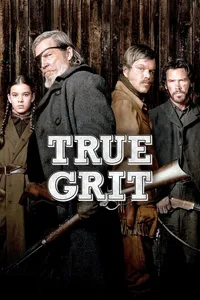
“True Grit“‘s end — there’s a flash forward — was the most irritating, movie-ruining gimmick I’ve seen since “The Curious Case of Benjamin Button.” It was “just then, when there was no way for our hero to survive, he awoke and discovered it was all a dream” bad. It was “and that little boy grew up to author the Taft-Hartley Act” bad. It was Shyamalan bad.
However, it had one of the best performances and finest characters — Mattie Ross, the 14-year-old heroine — I’ve seen since, hell, Edith in “Ghost World,” I suppose, ten whole years ago, or the Coen’s own Maud Lebowski in “The Big Lebowski.” Hailee Steinfeld arrives, negotiating with a crooked funeral home (is that redundant?) over the exorbitant cost of her father’s pine box (more shades of Lebowski here). The undertaker tries to distract her and tells her it would be OK if she kissed her father. Mattie will not be spoken down to. She is a monolith.
And that’s what I want to talk about: Hailee Steinfeld’s performance as Mattie Ross. It was about the only thing keeping me awake, fighting the soporific score by Carter Burwell, he who lost his already moderate sparkle after writing the orchestral sulk for “Twilight.” And look, I hate bagging on this movie. I love the Coen brothers, who wrote and directed. I adore Jeff Bridges, as U.S. Marshal Rooster Cogburn (namesake of my favorite ostrich ranch in Arizona). I love a good old timey motley crew revenge western, with mountain men wearing full bear skins and everyone all surly and surrounded by the brown, gold and black frontier. Hypothetically, that should be enough. I should learn from a man named Col. G. Stonehill, though, with whom Mattie negotiates shrewdly over her father’s affairs: “I do not entertain hypotheticals. The world is vexing enough as it is.”
Mattie doesn’t disagree with him. She’s our main gal and she’s got business to attend to. Her sudden orphanage — her father was killed by an assassin, the target of her vengeance — has made her cold and brilliant like stars in the winter, not weak and desperate for men’s help. Since the sheriff’s office won’t track a man into Indian territory, she needs a crew and she needs to get on her father’s killer’s trail, fast. As the opening title card (and Proverbs) has informed us, “The wicked flee when no one pursueth, but the righteous are bold as a lion.” (And if any kids poking and strangling a mule get in her gang’s way, Cogburn’s not above kicking them off a raised porch into the dirt.)
Of course, the men don’t fall in line behind their barely teenage leader. Texas Ranger LaBoeuf spanks her for being impertinent, then scorns Cogburn for going “from marauder to wetnurse.”
But Mattie is righteous. She is better at executing war than “Les Miserables”’ Cosette. She is a better escape artist than Little Orphan Annie. And she doesn’t have a whiff of Dorothy’s tearful soppiness to her. While she does once try to read Cogburn and LaBoeuf (Matt Damon, playing the butt of Cogburn’s jokes, mostly) a Bible story, she’s not playing an uptight 14-year-old spinster. And the thing I feared the most never happened: there was no forced plot twist that resulted in Mattie having to doll herself up, ditch the braids and the belted coat and the riding slacks and get all gussied up to prove her worth, er, beauty.
I did not enjoy this movie. But Steinfeld’s starring turn was perfection — good enough to gulp out of a filthy hoofprint. She, not the men, is the one with “true grit.”
Ashley O’Dell writes about movies that aren’t in theaters anymore.