Where the Sidewalk Ends
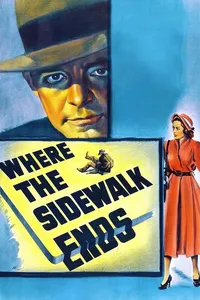
Det. Dixon (Dana Andrews) isn’t just late for the promotion ceremony of Lt. Thomas (Karl Malden) — he’s late to be chewed out and warned one last time that he’s just received 12 “legitimate” complaints of brutality. “From who?” Dixon snorts, “Hoods, dusters, mugs. Lotta nickel rats.”
This is about the most of Dixon’s personality we get to see. While investigating a stabbing at a gambling club run by a smooth-talker named Scalisi, a belligerent, drunk witness takes a swing at Dixon. Dixon fights back, unexpectedly knocking the man to the floor dead. See, Dixon wasn’t trying to be cruel or power-mad, but his victim, a Lt. Kenneth Paine, a decorated veteran, had a metal plate in his head, making the fall fatal. Dixon covers his steps, but when the body is found, ends up having to investigate the killing. When Paine’s father-in-law admits he came by that night, angrily looking for Paine because Paine had just beat his daughter the night before, hoping to have “slapped him silly,” the new commanding officer has the old man arrested for murder, something Dixon wants to overturn by having Scalisi falsely charged with the killing.
“Even Snooki took a punch better than that, LT.”
Impressed by what she sees as a devotion to her father’s innocence against the directive of his department, the old man’s daughter, the bruised Morgan Taylor (the radiant Gene Tierney) falls in love. A crusty old lady serves them soup at a local diner. On a scale of one to ten, their sparks rank about “Easy Bake Oven.”
Well, I guess *that’s *what Shel Silverstein meant by “Let us leave this place where the smoke blows black and the dark street winds and bends, past the pits where the asphalt flowers grow.”
Sometimes, it’s just impossible to get past the fact that someone, or a number of talented people, in the case of “Where the Sidewalk Ends”, have done such incredible work and then have followed it up with something inferior. “Where the Sidewalk Ends” is a fine movie, but having seen “Laura” (my review of it here) Preminger, Tierney and Andrews’ work is depressed. And this is somewhat understandable, since Andrews is playing a corrupt cop who can’t get out from under the shadow of his gangster father (why? Because of one measly comment from one thug?), and Tierney is a pitiful, dumb dame whose taxi-driving dad has been wrongfully jailed for murder, and who’s married to someone who came back from World War II a medal-draped veteran who actually does nothing but drink whisky and beat her. Preminger is out of form here, especially compared to the glorious (even when campy) “Laura” and the jaw-dropping Sinatra-starring junkie story “The Man with the Golden Arm.”
“My love for you is as hot as an iceberg wedge salad, baby.”
Unfortunately, so many times, an artist’s good work can work against them. “The Big Lebowski” is my favorite movie, and because of how tremendous it was — as were “Fargo” and “No Country For Old Men,” I was disappointed by the Coen brothers’ “A Serious Man,” “True Grit” (and “O Brother, Where Art Thou?” but I get dogpiled every time I say that out loud, because apparently comedy has no higher pinnacle than George Clooney being a priss about hair grease.) I rage about Wes Anderson movies in a similar way, because “Rushmore” and “The Royal Tenenbaums” were so different and funny and smart and weird and, but as soon as Owen Wilson left the writing team, the executioner of Twee hanged Anderson by his own scarf. (In slow motion. Set to “Powerman” by The Kinks.)
“Where the Sidewalk Ends” is a beautiful-looking movie, a glimpse in lovely shades of gray into a New York of overlapping neon signs, cigarettes, fedoras, satin hair and inky shadows. But what it has in pitch-perfect looks, it lacks in almost everything else, which is frustrating and unfortunate because all the ingredients were there for a knock-it-out-of-the-park classic (and some people think it is such; to each his own). There are moments of interesting dialog, like when Dixon tells Morgan, who’s offering to “fix his head” after a fight, that she’d better “use an ax,” but they’re rare. The purported gang boss, the cool-headed Scalisi, doesn’t do anything terribly evil, making it hard for the audience to want to see him take the fall for a murder he didn’t commit. Dixon isn’t hard-boiled; he never gives us any suspense by making us think he’s going to let the innocent cabbie take the heat for the murder, and instead he just comes off as a crummy bully cop with daddy issues whose eventual confession is about as passive-aggressive as it gets. The attraction between him and Morgan Taylor, who seems OK with being beaten up and lied to without even flinching, is room-temperature. It’s easy to feel sorry for her — and for the production as a whole.
Ashley O’Dell reviews movies that aren’t in the theater anymore. She lives in North Hollywood, near the In-N-Out Burger.