World's Greatest Dad
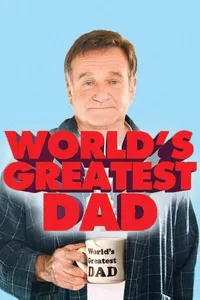
If Bobcat Goldthwait’s “Shakes the Clown” was the “Citizen Kane” of alcoholic clown movies — as the Boston Globe has said — then his “World’s Greatest Dad” is the “Citizen Kane” of teenage autoerotic asphyxia movies.
Goldthwait’s second effort at writing and directing a feature-length film, the story of a literary romantic and the death of his sweaty, brutish, perpetually masturbating son, is an utterly Stygian comedy, surprising and impressive in its range from cynicism to tenderness.
Dad (Robin Williams) is a poetry teacher at a private school. His lunkhead son Kyle is an aimless, perverted jerk whose opinion on music is that it’s “faggy.” His girlfriend is becoming untethered in the direction of a charismatic coach who, on his first try writing, gets a sports-racism-robotics story called “I, Forward” published in the New Yorker. His students crib Queen lyrics and submit maudlin verses about miscarriage. No one will watch his beloved zombie movies with him, nor read his unpublished books — “Door-to-Door Android,” “Darwin’s Pool,” “The Narcissist’s Life Vest,” and “The Speed of Bad News.”
Lance soon finds out plenty about the “speed of bad news” when he walks in on Kyle, accidentally choked to death while practicing his favorite hobby to under-the-table cell-phone pictures of Dad’s girlfriend. Wordlessly, his dad tenderly cleans things up, hoists his son gently to his pull-up bar and types a heartfelt suicide note.
The ensuing cascade of events at school, following the school newspaper’s unearthing and publishing of Kyle’s note is as disconcerting as it is deeply loving. The letter strikes a nerve. Students start talking to the school counselor. The charismatic coach exposes himself as a grief-leaching bubblehead in a single, choked up line about his son (who we learned early on is 2 years old): “If Hunter ever did something like that, I don’t know what I’d do.”
Lance whips up a “journal,” a raw touchstone that turns Kyle from rightfully hated jerk into a deeply misunderstood, haunting and evocative hero. Lance, his writing talents redeemed by readership, gets to bask in some of that reflected glow. Seeking more information about their departed classmate, the girls he went to school with beg Lance for the music Kyle liked. Lance hands over his CDs of sensitive, talented, yet slightly pathetic Bruce Hornsby — the same music Kyle punched off and dismissed as “faggy” in the opening scene.
In a way, in following the arc of someone’s influence after their death, “World’s Greatest Dad” is sort of a zombie movie. In death, Lance creates a son who loved his father and was sorry for his wasted life. Quoting “Shaun of the Dead” creator Simon Pegg, Lance says early on that “Death is an impediment, not an energy drink.” Yet, in Kyle’s case, it’s the opposite. He was an impediment in life. His repackaged death is at once resuscitation and Red Bull.
One hopes this is a turning point for Robin Williams, away from crippling pseudo think-comedies like “Man of the Year” and terminally misanthropic summer fare like “RV,” where his roles alternate between trying-too-hard mania and focus of scorn.
At the end of the movie, Lance is asked to speak at a dedication of the school library, to be named after Kyle. It’s a surprise to no one in the audience that he’s compelled to fess up, but he does so saying this: “I used to think the worst thing in life was to end up all alone. It’s not. The worst thing in life is ending up with people who make you feel all alone.” In slow motion, Williams runs, floats through the halls, popping buttons, tearing his business clothes from his aging, pale body to the tune of “Under Pressure” — all the way to the edge of the high-dive board, his old college talent, in his aqua-blue socks. He dives in, emerging with bubbles streaming from his nose, grinning. He doesn’t look like a man hating himself for his deception and emptied by the death of a family member. He looks free. Happy. Alive. It’s Lance — and I hope, Williams too — coming up for air.
Ashley O’Dell reviews movies that aren’t in theaters anymore.